
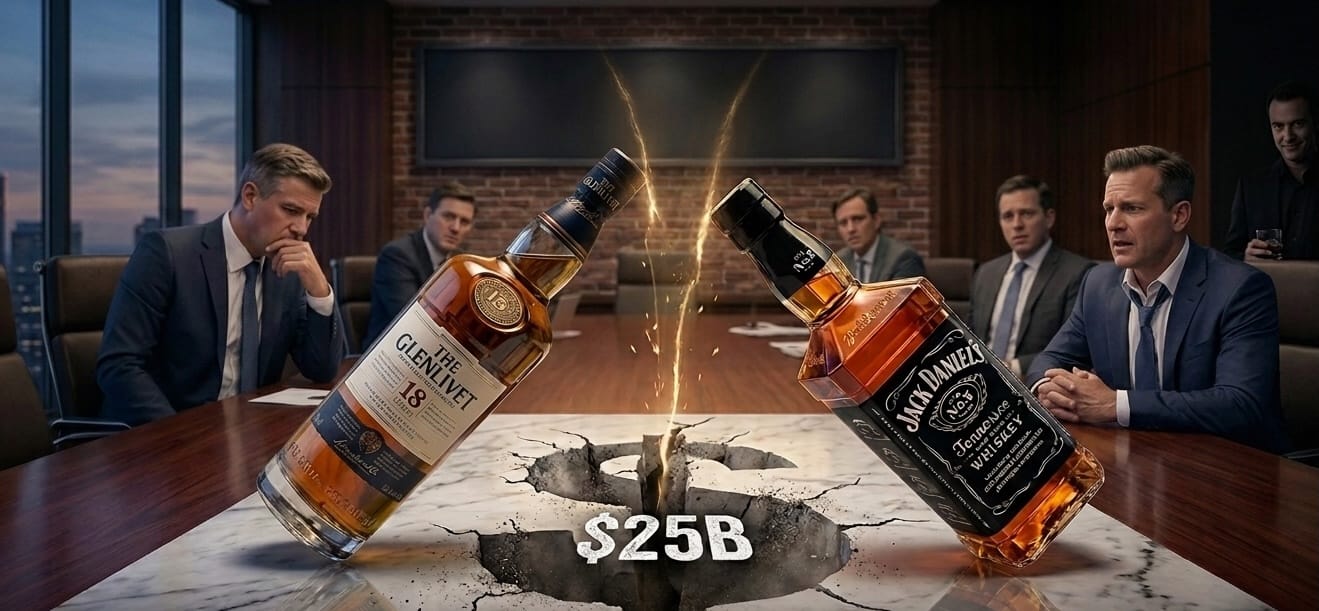
The merger that would have redrawn the global spirits map is dead. Pernod Ricard and Brown-Forman confirmed on 28 April that talks have ended — citing economics, debt, and governance misalignment. General business press called it a valuation disagreement. That framing misses the more consequential story: in travel retail, this deal collapsing may matter as much as it would have closing.
Pernod Ricard confirmed merger talks with Brown-Forman on 26 March 2026 — a proposed merger of equals that would have created a $25 billion spirits group capable of challenging Diageo's global dominance. Thirty-three days later, it was over. Both companies cited an inability to agree on deal structure and economics. A Pernod Ricard spokesperson described the termination as mutual and attributed it to a combination of structural and economic elements rather than any single issue. Brown-Forman's official statement pivoted immediately to independence, promising to unlock future growth through geographic expansion.
The collapse was accelerated by two forces. First, mid-April saw Sazerac — the private, family-owned distiller behind Fireball and Buffalo Trace — launch a $15 billion all-cash counter-bid for Brown-Forman at $32 per share. Second, the Brown family's 67 percent voting control, held continuously since 1870, created an insurmountable governance impasse. The family reportedly favoured the Pernod structure but could not reach alignment on control terms. Markets delivered their verdict swiftly: BF shares fell 10 percent to $24.89 on the announcement. JP Morgan downgraded the stock to underperform and cut its price target to $23.
Business journalists measured this deal in debt ratios and synergy projections. Travel retail practitioners should be reading it differently. The airport spirits aisle is approximately 12 to 15 percent of premium spirits volume globally, but it punches well above that weight in margin and brand-building. Duty-free is where premium positioning is cemented, where gifting drives impulse spend, and where exclusive formats command prices that don't exist in any domestic market.
The combined Pernod-BF entity would have assembled a portfolio with no precedent in the airport environment. Jameson, Chivas Regal, and Martell on one side; Jack Daniel's, Woodford Reserve, and Herradura on the other. One supplier. One negotiating team. One allocation lever across Irish whiskey, Scotch, Cognac, premium bourbon, and super-premium tequila. The travel retail implications were existential for operators and competitors alike — and yet nobody in mainstream coverage mentioned them once.
Why the airport spirits aisle dodged a near-monopoly
Pernod Ricard already occupies an enviable position in global travel retail. Chivas anchors the Scotch bay. Martell commands Cognac, particularly in Asia-Pacific. Jameson has become the default Irish whiskey recommendation from every airport spirits consultant in every hemisphere. Adding Jack Daniel's — the single best-selling spirits brand by volume in global travel retail — would have handed one supplier category dominance across four of the five highest-grossing spirits segments at airports worldwide.
Duty-free operators and concession managers at Avolta, Lagardère, and DFS were not openly lobbying against this deal. They didn't need to. But procurement teams at the world's largest travel retailers understood the negotiating mathematics clearly: a merged entity of this scale would have fundamentally restructured listing conversations, exclusivity negotiations, and promotional budgets. The quiet relief in those offices this week is entirely rational — and entirely unreported.
When one supplier controls Irish whiskey, Cognac, bourbon, and Scotch, the airport aisle stops being a shelf and becomes a hostage.
What you wouldn't have read elsewhere — the family arithmetic
The Brown family's 67 percent voting stake is universally framed as a heritage story — generations of bourbon loyalty, stewardship of an American icon. That framing is accurate but incomplete. In travel retail, continuity of ownership is a competitive asset. Airport concession contracts are relationship-intensive, multi-year agreements where trust between brand house and operator is commercially material. The Brown family's unbroken stewardship of Brown-Forman since 1870 is not sentiment; it is structural credibility in those conversations.
A merger would have triggered 18 to 24 months of internal restructuring — brand house reorganisation, sales force integration, regional leadership changes. In that window, every Jack Daniel's airport listing would have been negotiable, every Woodford Reserve exclusivity arrangement revisable. Competitors — including Diageo's entire American whiskey portfolio — would have moved aggressively into that uncertainty. The Brown family almost certainly understood this. Their inability to align on governance terms may have been, at least in part, a rational calculation about travel retail continuity dressed in the language of corporate structure.
Pernod Ricard India is the company's number one growth market globally — a position built on decades of distribution infrastructure, regulatory navigation, and deep retail relationships across one of the world's most complex alcohol licensing environments. Brown-Forman, by contrast, has minimal presence in India. Jack Daniel's trades there as a niche premium import, without the distribution depth or retail relationships that would accelerate its growth in a market moving fast toward premiumisation. A merger would have changed that overnight. Jack Daniel's would have inherited Pernod's Indian distribution machine, its airport concession relationships, and its regulatory familiarity — at precisely the moment Indian airport passenger volumes are scaling to rival European hubs.
India's duty-free environment is one of the most dynamic in the Asia-Pacific region right now. New terminals, expanding international routes, and a rising cohort of outbound travellers with strong whiskey affinity were set to make Indian airport TR a showcase for a combined Pernod-BF American whiskey push. That strategic shortcut no longer exists. Brown-Forman's official statement spoke of expanding geographic footprint independently — but building India distribution organically, without Pernod's infrastructure, is a five-year project minimum. In travel retail terms, that runway has just got significantly longer.
Things to carry away
- The Pernod-BF merger would have created an airport spirits near-monopoly across bourbon, Irish whiskey, Cognac, and Scotch — a concentration of shelf power that had no precedent in travel retail history.
- Duty-free operators and procurement teams at major travel retailers were structurally disadvantaged by this deal; its collapse restores negotiating balance across the category.
- The Brown family's governance impasse was not only about heritage — it was a rational calculation about the cost of 18-24 months of integration disruption to hard-won airport concession relationships.
- Sazerac's all-cash bid is the most consequential live development in spirits M&A right now; a Sazerac-BF combination would create a whiskey-plus-flavoured-shots travel retail proposition with genuine disruptive potential.
- Indian airport travel retail loses its fastest route to a premium American whiskey wave; BF's independent path to India distribution is years longer than the Pernod shortcut would have been.